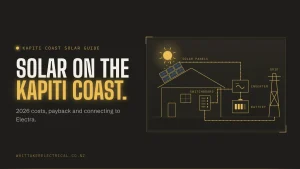

Power bills keep climbing. Consumer NZ forecast another 5% rise in 2026 after a 12% jump in 2025, and more Kapiti Coast households are asking the same question: do solar panels actually add up here?
This guide covers what solar costs in New Zealand in 2026, how payback really works, whether you need a battery, and the local steps – from connecting to Electra’s network to building consent – so you can make the call with real numbers.
What does solar cost in New Zealand in 2026?
A typical 5-10kW home system costs between $10,000 and $20,000 installed, according to RNZ’s 2026 reporting, and a battery adds roughly the same again.
MySolarQuotes’ analysis of 279 residential quotes, published in September 2026, lands in the same range:
- 5-7kW system: median $12,148
- 7-9kW system: median $17,201
- 9-12kW system: median $19,616
- Solar plus battery (about 9kW of panels and a 9kWh battery): median $31,480
Across all the solar-only quotes, the median worked out at about $2.14 per watt. The final price for your home depends on your roof, your switchboard and how much power you use.
How payback works – and why using your own power matters most
Every unit of solar power you use at home replaces a unit you would otherwise buy. Wellington households pay around 37c per kWh on average, so that’s what each self-used unit is worth.
Every unit you export to the grid earns a buy-back rate instead. In October 2026 most retailers paid between 8c and 17c per kWh (excluding GST), with some plans paying higher peak export rates of 19c to 27c at set times of day.
That gap is the whole story. The more of your solar you use yourself, the faster the system pays for itself. Across the 2026 quotes above, the median quoted payback was 6.9 years for solar only and 9.0 years for solar with a battery. Those are installers’ estimates rather than measured results, but they’re a useful guide.
Simple ways to use more of your own solar:
- Heat the hot water cylinder in the middle of the day instead of overnight
- Run the dishwasher, washing machine and dryer in the sunny hours
- Warm or cool the house with the heat pump while the sun is up
- Charge your EV during the day, or use a smart charger that follows your solar output
Do you need a battery?
Not to start with. Solar works well on its own, and a battery adds significantly to the cost. But a battery changes the maths in three ways:
- You keep more of your own power. Instead of exporting your daytime surplus for a few cents, you store it and use it in the evening, when you would otherwise pay full price.
- You can earn peak export rates. Some retailers pay more for power exported during the morning and evening peaks, which is only possible with stored energy.
- You can have backup. With the right inverter and wiring, a battery keeps essential circuits running during a power cut. A standard grid-tied system switches off in an outage for safety.
In the 2026 quote data, adding a battery lifted median yearly savings from about $2,475 to $3,299, but added around two years to payback. If someone’s home during the day, solar alone often makes the most sense. If the house is empty until evening, or backup matters to you, a battery is well worth pricing.
Grid-tied, hybrid or off-grid?
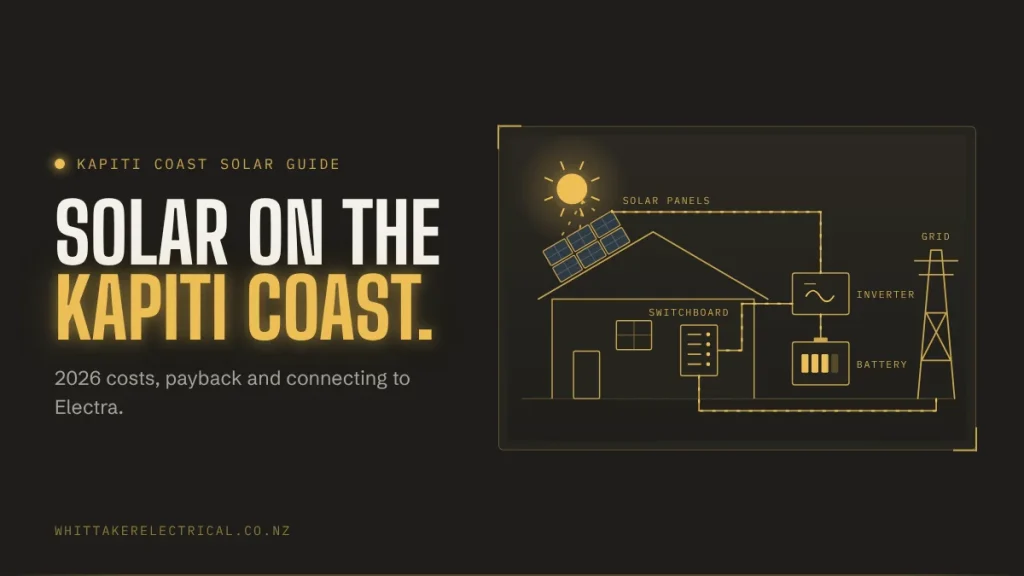
- Grid-tied: panels and an inverter, connected to the network. The simplest and most affordable option.
- Hybrid: solar plus a battery, still connected to the network. You use more of your own power, with backup if it’s designed in.
- Off-grid: fully independent, with a larger battery bank and usually a generator for long grey spells. It suits lifestyle blocks, farms, sheds and baches where a network connection is costly or not possible – and there are plenty of those on the Kapiti Coast, from the hills behind Waikanae to rural Te Horo and Otaki.
Connecting solar to the grid on the Kapiti Coast
On the Kapiti Coast, the local lines network is run by Electra, and every grid-connected solar system needs Electra’s approval before it can export. Your installer makes the application, not you. For a home system of 10kW or less, the process looks like this:
- Talk to your power retailer about buy-back options and whether you need an import/export meter.
- Your installer assesses the site and lodges the application with Electra.
- Electra approves it, asks for changes, or declines it.
- Once it’s approved, the system is installed, tested and commissioned, and your installer issues a Certificate of Compliance (CoC) and an Electrical Safety Certificate (ESC).
- Electra may inspect the site, and then you’re connected and exporting.
Systems over 10kW – common for businesses and farms – go through a longer, two-stage process with Electra, including technical requirements and a formal connection agreement. Off-grid systems skip this step entirely, because there’s no network connection to approve.
Do you need a building consent?
Usually not. Since 23 October 2025, roof-mounted solar arrays under 40 square metres don’t need a building consent, as long as the site is in a wind zone no higher than “high”. Larger arrays, or sites in a higher wind zone, can still go ahead without consent, but the design must be carried out or reviewed by a Chartered Professional Engineer. Either way, the install still has to meet the Building Code and the district plan.
Exposed coastal and hill sites can sit in higher wind zones, so it’s worth checking early. Your installer should confirm which rules apply to your property.
Is solar worth it for your home?
Solar tends to pay off best when:
- You have a roof facing north, east or west with little shading – north is ideal in New Zealand
- Someone’s home during the day, or you can shift big loads into daylight hours
- You have, or plan to get, an EV, a heat pump or electric hot water
- You plan to stay in the house for at least the payback period
Shading and roof direction make more difference than which part of the country you live in, so a site visit tells you far more than a postcode.
Talk to your local solar electricians
Whittaker Electrical designs and installs solar panel and battery systems across the Kapiti Coast, from Levin to Pukerua Bay – grid-tied, hybrid and off-grid. We handle the Electra application, any switchboard upgrades and the certification, so the whole job stays with one local team. Thinking about an EV too? We also install EV chargers that can run off your solar.
Call us on 021 975 911 or send us a message, and we’ll arrange a site visit and a written quote for your property.